
Interbetin
info General information
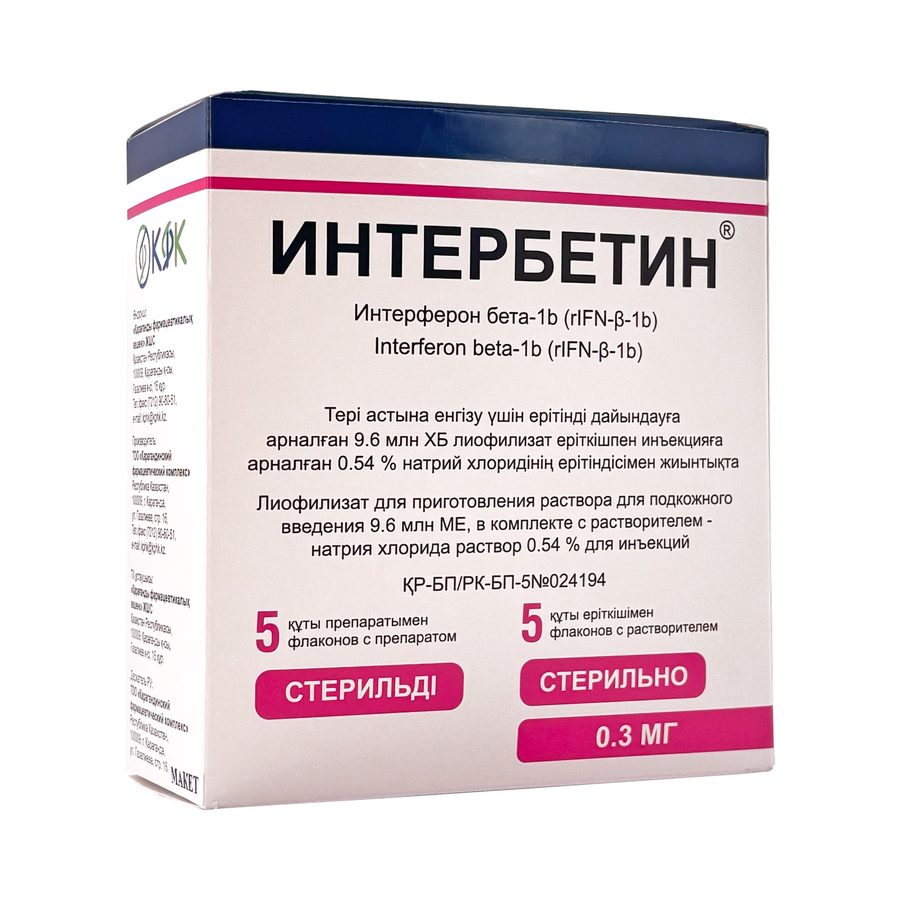
0.3 mg (9.6 million IU) of the product in glass vials. 1.2 mL of solvent (sodium chloride 0.54% solution) in glass vials.
5 vials with the product and solvent are placed in blister packs.
1 blister pack with the product and solvent, together with disposable medical supplies: 5 syringes of 1 mL, 5 syringes of 2 mL, 10 long needles (for solution preparation), 5 short needles (for subcutaneous administration), 10 alcohol wipes, or 5 syringes of 1 mL supplied with short needles, 5 syringes of 2 mL supplied with long needles, 5 long needles separately, 10 alcohol wipes, is placed in a cardboard box.
assignment_turned_in Indications
- Clinically isolated syndrome (CIS)
The only clinical diagnosis indicating a single occurrence of symptoms very similar to multiple sclerosis, but test and MRI findings do not yet allow a definite diagnosis of MS. Intravenous corticosteroids are prescribed to slow the progression to clinically definite multiple sclerosis (CDMS).
- Relapsing-remitting multiple sclerosis
People with relapsing-remitting multiple sclerosis experience attacks or relapses from time to time, during which symptoms noticeably worsen. Interferon beta-1b has been shown to reduce the number of attacks and make them less severe. This reduces the number of hospitalizations for the disease and prolongs the relapse-free time.
- Secondary progressive multiple sclerosis
In some cases, people with relapsing-remitting multiple sclerosis find that their symptoms become worse and they progress to another form of multiple sclerosis called secondary progressive multiple sclerosis. These people find that their condition worsens whether or not they have relapses. Interferon beta-1b reduces the number and severity of attacks and slows the progression of disability.